Wednesday, May 6, 2015

Answering Extroverts' Questions About Introverts

This past week, a question popped up on Reddit asking extroverts what they just didn't get about introversion... so I figured it would be cool to respond to some of these questions here on my blog. Some of these tap into common introvert misconceptions, while others are more a matter of "I get you guys, I just can't imagine wanting to be like that." So here goes:

Q: Why do you think introversion is related to liking books or being smart?
Caught Reading from Flickr via Wylio
© 2007 Jayel Aheram, Flickr | CC-BY | via Wylio

A: Well, a lot of introverts are big readers. It's a hobby you can do on your own, and we like those. But a lot of it ties into the reverse stereotype that smart = nerds = introverts (also not always true). Many nerds do self-identify as introverts, so sometimes the assumption is that introverts are all smart nerds. Introverts also tend to spend a lot of time thinking and learning about specific hobbies, so they can be very very knowledgeable on specific topics. I've also learned that when you speak less (as introverts often do) and reserve dialogue for when you know you have something worth saying, people think you're smarter than you are because they don't hear the stupid thoughts that pass through your head first.

Q: WHY WON'T YOU TALK TO ME?

A: Maybe because you're yelling at me?

In all seriousness, the person who wrote this was frustrated by the fact that he couldn't get an introverted person to hold a conversation with him. If someone isn't talking to you, there's probably one of two things going on: 1) They're not only introverted but incredibly shy and don't open up very easily, or 2) They don't particularly want to talk to you, so they don't.

Unfortunately, with shy introverts, it can be hard to tell the difference between these two. What you absolutely should not do is push and push for more conversation and try to "break through" somehow. If they don't like you or don't want to talk to you, that'll make them more annoyed, and if they're shy, that'll overwhelm or intimidate them. Be consistently friendly but give them space, and if they want to come to you, they will.

Q: I don't get it when introverts need time alone to recharge themselves. Like what does recharge even mean in this context?

iPhone screenshot showing battery charging from Flickr via Wylio
© 2009 Jodiepedia, Flickr | CC-BY | via Wylio
A: Exactly what it means for a battery: We run out of energy. For a lot of us, there's a physical shift we can feel. I start getting incredibly mentally tired, like when you've been reading or studying for a long time, and the process of listening or talking to anyone just seems like more effort than it's worth. Everything seems loud and everyone seems to be demanding your attention and you just want to go home and be quiet for awhile.

My favorite analogy is from Donald Miller, who compared introversion to having to jog during every conversation. That's absolutely right for me. Sometimes it's worth it, and I can jog for longer, but sooner or later I'm just exhausted, and I need to lie down by myself where no one is going to start asking me questions.

Q: Why are you more comfortable talking to strangers on a websites, but not one in a bar or real life?

A: I've written about this before on this blog, so let me reiterate some of the points from there. We often feel more comfortable online because there's no pressure on us to keep the conversation going. In real life crowds, we're very aware that we have a social responsibility to keep up the talk. Online, there's less of that, so we can relax and open up without scrambling for something to say in time, before they other person starts feeling awkward.

It also gives us the chance to really think about what we say. Introverts often process their thoughts internally, so they may not speak until they're certain they know what they want to say and how they want to say it. In real life, by the time we get there, the moment's passed, but online, it's easier to hold off until you're ready.

I'm almost equally comfortable talking with close friends who understand when I need to just sit and think and process for awhile, without pressuring me to keep talking.

Q: I can understand needing alone time in fact I quite enjoy being on my own sometimes, but I cannot grasp the idea that you can be alone ALL the time and not want to go out, meet new people, and ultimately open up new opportunities for yourself.

A: Well, most introverts don't want to be alone ALL the time. But one thing to consider is that what you may think is all the time, they may think is not. For example, if an introvert works with people, they're around people all day, and when they come home, they just want to be by themselves. I've known extroverts who feel like that's "being alone all the time," but for an introvert, they feel like they're with people all of the time, and we're claiming our last few hours of free time to recharge.

Also, introverts can be adventurous and open up new opportunities for themselves and want to go out without wanting to be particularly social. I've discovered it's really invigorating for me when my husband and I explore our local city on weekends. But that exploration is never going to include clubs or parties or socializing in bars. I seek out new opportunities, I'm just seldom interested in making it about socializing.

Q: I don't understand why you wouldn't put yourself out there when there are so many interesting people out there. Some of the people I've met in the most random situations have ended up being some of my best friends. It's true that strangers are just friends you haven't met yet.

WWW_D3_Mingle-35 from Flickr via Wylio
© 2011 worldwaterweek, Flickr | CC-BY | via Wylio
A: This is one of the biggest differences between a lot of extroverts and me -- I'm extremely picky about my friends. I do have a lot of friends, but I can't connect with just anybody. There are people I've known and socialized with for years who I wouldn't say are my friends, no matter how interesting they are.

Not to mention the fact that the early stages of meeting people are the least interesting to me. It's the stage when there's the most small talk (which I find incredibly boring) and the least discussion of substance and the most uncertainty about whether I can be myself yet. That's a lot of effort put into something that certainly has no guarantee of a positive end result.

I just have a limited amount of energy, and putting it toward new "random situation" relationships that may or may not last is often a poor use of it.

Q: I don't get why introverts seem to have fun with other people and generally are cool to do fun activities yet they never take initiative to organize something like that, why do I as an extrovert always have to do this? It's not really a question, I'm just tired and feel under-appreciated.

A: Well, we don't tend to organize large group events because we don't tend to like large group events -- at least not enough that we want to have some of our own. We may tag along to others because we do want to be social (yes, it happens) or we want to spend time with certain people or we're bored, but it's hardly ever our activity of choice. We're more likely to schedule smaller group activities, or even one-on-one social times.

Don't think of it as "I'm doing all these things for other people and they won't do it for me either!" and think of it more as "I'm getting to spend time with my friends in a way I think is fun," and let them initiate the things they think are fun for them -- even if that never includes group bowling or a whole crowd going to the movies together.

Q: Are introverts really self-conscious or do they genuinely just like to be alone?

A: Well, sometimes we are really self-conscious, but I promise we genuinely like to be alone. It's marvelous and relaxing.

Q: Why? People are the best! I love people! I would get if you guys just disliked certain people for being douchenozzles, but as a general rule, I find that all the people I know are genuine and kind.

It's not that we dislike people so much as we dislike groups, and we dislike meaningless socializing. An introvert can have a great time with a deep one-on-one discussion about something they love, but most of the socializing we're called upon to do doesn't give us that kind of opportunity. It feels more like mindless work where we're all just trading pleasantries and never really get to know anybody. (I startled a friend of mine once when I said I didn't feel like I knew anyone if I'd only spent time with them in a group. But it's true -- I'm not good friends with anyone I haven't spent some kind of one-on-one time with.)

Because of that, it's much easier to retreat from typical social activities and to not socialize with people with whom we don't see potential for something deeper.

Coffee Date from Flickr via Wylio
© 2012 York Berlin, Flickr | CC-BY-ND | via Wylio
Q: What is an ideal date? A first date or thereafter? Sometimes it's really hard to tell if you're enjoying the conversation or are uncomfortable.

We like our one-on-one time, so anything where you guys can really spend time together. How that looks will vary from person to person. Personally, I'm all about dinner-and-a-movie, but preferably movie before dinner. That way we can do a fun activity together (seeing a movie) and have some good conversation about it afterward. As far as whether we're enjoying ourselves or now, we can take a little while to open up, so don't automatically assume we're not having a good time.

Q: Why they won't just share their thoughts. If something is inside my head, I spit it out (I filter of course so I am not rude). I've had it explained to me 30 ways to Sunday, and I will just never understand it.

There are two things going on here: Introverts not sharing their thoughts when you ask, and introverts not sharing their thoughts randomly. The first is less common than the second (typically introverts will respond if you ask them a direct question; that's just polite). So let me assume you mean the second.

The basic answer is because we're being polite and/or private. This sounds rude to say, but 90% of the time we just don't care about the random thoughts of the people around us. And in return, we assume they don't care about ours. I barely care about my own. Why would we subject you to a conversation we deem boring?

This also gets into the fact that a lot of us don't like filling the air with random speech. We prefer to speak when we have something to say. Sharing our thoughts out of nowhere with people we don't think will care (because those thoughts are just not that interesting most of the time) feels like a waste of breath and a crappy time for all involved. So we don't.

Q: Do you dislike all mediums of human interaction, or only face to face?

Again, this is hitting an unfortunate stereotype being perpetuated in this wave of introvert pride. We don't "dislike all mediums of human interaction." We don't even dislike face to face interaction. We find it *draining*. When we strongly dislike it, it's because it is taking up time and energy we can't spare. It's like being forced to run around the block every time you step outside. Sometimes it's refreshing and it feels good, even if you are tired at the end. Other times, you avoid stepping outside at all because you just don't want to run around the block for the fourth time today.

That being said, I personally find phone interaction more draining than face-to-face, but online interaction the least draining of all. That's not unusual among the introverts I know, but then most of us met online, so I'm sure there are many who feel differently.

Q: What's it like living on the other side of the fence? What makes you enjoy being a "homebody" type of introvert?

Oh, man, being a reserved homebody type of introvert is lovely. Whenever you get home from being out all day and you can just sit on your couch with headphones on and not talk to anyone, it's like kicking off uncomfortable shoes.

I'm not a homebody ALL the time. I like to travel, I like to try new things, and I do even occasionally like to meet new people. :-) But it's so beautiful coming home to recharge after all that. You walk in the door and all the defenses come down.

The Lonely Man from Flickr via Wylio
© 2011 Mick C, Flickr | CC-BY | via Wylio

Q: Don't y'all get lonely?

Sure, we do. I wrote a blog post about that too.

Q: When I want people to like me I make them like me. How do you make friends?

Very slowly.

In all seriousness, it takes a long time for me. I told this to a classmate of mine in college, after we'd been hanging out in groups for a couple of months. She said, "So we're only kind of friends?" I said yes. From then on, it was a running joke that that year we were just "kind of" friends, the next year we were "almost" friends, and then our last year together, we were legitimate friends. And we joked about it, but that's kind of how it works.

As I said above, I also don't consider someone a friend unless we've spent some quality one-on-one time together. In practical terms, if I wanted to develop a closer friendship with someone, I'd probably invite them to do something just the two of us -- go see a movie together or grab lunch together and chat. That's the only way I feel like I get to know someone at all.

Q: What is so hard about saying "hi" and just talking to other people?

It's not hard, it's just exhausting, especially when the conversation isn't meaningful or interesting. Feigning interest in something that feels meaningless is a lot of work.

Q: Do you try to be an extrovert?

Yeah, that was the first 21 years of my life. I was terrible at it and then I felt bad all the time for being terrible at it because I thought that good people (and especially good Christians) were extroverts. That was a gross time of my life.

Q: Is being at a social event awful or can you be comfortable hanging around on the edges of conversations, etc?

There are degrees of awfulness. At social events, I'm very likely to just latch on to one or two people and have longer conversations with them. It may still be uncomfortable, but it'll be much less so. Being in the middle of a socializing crowd where I don't know anyone -- really, truly unpleasant. "I can't wait to go home" unpleasant. Or being in the middle of a loud crowd where conversation is impossible. *shudder*

Q: Going to a late-night movie with a group of friends & then sitting outside at an In-n-Out eating burgers at midnight is AMAZING. How can that "drain" you?
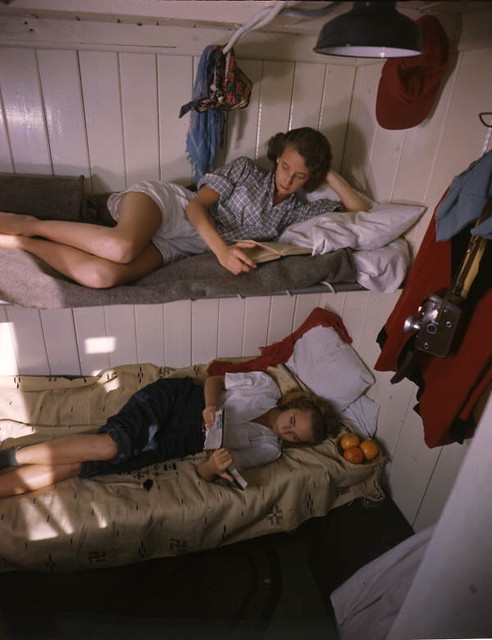
Young women reading aboard the shantyboat Lazy Bones from Flickr via Wylio
© 1947 Florida Memory, Flickr | PD | via Wylio
Hey, just like you're baffled by that, I'm baffled by how you would ever turn down a lazy Saturday watching movies at home in your pajamas without talking to anyone -- or ruin that day by filling it with busywork :-)

In all seriousness, though, you're assuming that amazing things can't be draining. We just hit our "too much of a good thing" meter much more quickly than you do.

One of the things I've tried to communicate to my extrovert friends (not always successfully) is that I do like to spend time with them. I do. I just run out of air more quickly than they do. And if you try to pressure me to stick around when I'm out of air, I'm not going to suddenly start having fun again. I'm going to get more and more unhappy because I can't breathe, guys, and you're not going to enjoy my company and I'm not going to enjoy your company. So the best method is for me to go home, breathe in my own room for awhile, and then be ready to hang with you again sometime soon -- which I'm much more likely to do if I know that you're comfortable with me leaving whenever I need to!

Those are the main questions from extroverts I wanted to answer. Extroverts, do you have any more? Introverts, do you have your own answers to these questions? Share in the comments!

Monday, May 4, 2015

The Top 100: Casablanca

Today's Top 100 rewatch is actually the #1 movie on my Flickchart: Casablanca. I've named it as my favorite movie for a long time now, probably since middle school, and, truth be told, I'm wondering if it's time for it to give up its title. Don't get me wrong, it's still a fantastic film, but last time I watched it, it just didn't connect to me quite as strongly or as emotionally as some of the other movies in my top 20. But we'll give it a chance today to prove it belongs in the #1 slot.


Often listed in critics' "best films of all time" lists, Casablanca is a 1942 romantic war drama about a cynic named Rick (Humphrey Bogart) who runs a night club in unoccupied French Morocco, one of the last stops on the road for World War II refugees escaping to America. One night, a woman from his past (Ingrid Bergman) appears in his club and everything changes.

As before, I'll live-blog my movie thoughts as I watch (plenty of spoilers here!) and I'll write up a more complete review later.

  • This opening music makes it seem much more like a swashbuckling adventure than it is.
  • Love the shot of everybody mournfully looking at the departing plane. This movie is really lovely to look at.
  • There's a fantastic contrast in this opening scene at Rick's. Such cheerful music but everybody in there is miserable and desperate. What great atmosphere.
  • I like Bogart in a lot of films, but I think he's REALLY good here. Lots of nuance.
  • When black and white movies make use of shadow, it's just gorgeous.
  • This dialogue is really excellent. It's no surprise it gets quoted all the time.
  • "As Time Goes By" is one of my favorite songs from a movie.
  • Captain Renault is always fascinating. His casual charming flippancy makes him an interesting quasi-antagonist because he understands a lot more than his demeanor leads you to believe.
  • "She's coming back, I know she's coming back." What a quietly heartbreaking line.
  • The innocence and naivete of Rick and Ilsa's relationship in Paris is really interesting to me this time around.
  • Ilsa's last speech to Rick before he leaves Paris is lovely and sad.
  • "And what if you track down these men and kill them, what if you killed all of us? From every corner of Europe, hundreds, thousands would rise up to take our places. Even Nazis can't kill that fast."
  • I like that Victor is given some depth of character and is not just the hero archetype.
  • The scene with the young Bulgarian girl and Rick is a beautiful one. So compelling.
  • Rick's constant fight between cynicism and his deeper sense of morality is wonderful to watch play out.
  • Yay, the "La Marseillaise" scene. This is one of my favorite scenes of all time in any movie.
  • I think one of the things that makes this dialogue so fascinating is the constant forced diplomacy, where people very carefully avoid making threats or promises, but the most innocent lines convey much more ominous purposes.
  • Victor is really a very good guy. His interaction with Ilsa where he gives her an opening to talk about Rick makes me feel so bad for him, knowing she doesn't love him the same way.
  • "One woman has hurt you, and you take out your revenge on the rest of the world."
  • "Welcome back to the fight. This time I know our side will win."
  • The foggy visuals in the whole airport scene are truly beautiful.
  • What a wonderful ending.

As you can see, the movie still holds up. In fact, it is one of those that improves upon multiple viewings because the plot's pretty complicated, and once you have a good grasp on the plot, you can really admire the music and the cinematography and the acting and the writing and the depth of the whole shebang. Even if this doesn't end up staying in my #1 spot, there's no doubt it's really impressive. It might actually be a perfect movie.

So if I think it's a perfect movie, why would it possibly drop from #1 on Flickchart? Well, because as much as there is to admire and love about this movie, I don't feel that deep an emotional connection to it. The final scene is stirring, and the abovementioned "La Marseillaise" scene is an incredibly powerful few minutes of cinema, but overall I find myself drawn to it more on an analytical level than on an emotional one. That doesn't mean it isn't amazing, it doesn't even mean it's not deserving of my #1 spot, but it might mean that if I had to choose a single movie to represent me and my tastes or to be the movie I love most for the rest of my life... it might not be this one.

Of course, my feelings could change as I rank, when I'm forced to compare it to other movies I also love. So let me give it a shot and see where this ends up. Good luck, Casablanca.


vs. Where the Wild Things Are (2009) - Not even a tiny bit of a contest here. (As I suspect will be the case for most of my top 100 movies and the first match-up they encounter.) Casablanca steamrolls right over the creepy monsters from this movie.

vs. Argo (2012) - Argo was one of my favorite Best Picture nominees from a fairly weak year, but it's pretty fluffy, if fun, and doesn't seriously measure up to Casablanca.

vs. American Splendor (2003) - I remember thinking American Splendor was interesting but not stunning, so Casablanca wins again.

vs. Indiana Jones and the Last Crusade (1989) - As much as I enjoy Last Crusade, it's not going to win here. It's just not as meaningful.

vs. The Lion King (1994) - So far, Casablanca has held onto its #1 spot, and... it will continue to do so against Lion King. The movie looks great and has amazing music, but I can't in good conscience let Casablanca lose to an animated movie that gets so many of its jokes out of anachronistic pop culture references, which is a trend I hate.

vs. The Odd Couple (1968) - OK, this is a much tougher call. I think this is Neil Simon's best script, and Walter Matthau and Jack Lemmon knock it out of the park. That being said, Casablanca's still going to take it. The Odd Couple is light, fluffy fun, but, again, there's meaning to Casablanca, and I can't discount that.

vs. Into the Woods (1991) - This is a movie that is almost certainly higher than it should be, as it's sitting in my top 20 and should probably be much lower. Casablanca wins.

vs. The Truman Show (1998) - OK. This is where things get difficult. This is the first one I think Casablanca might actually lose. Now, I might be overestimating how much I love The Truman Show (and if it jumps further down when I rewatch it as part of this challenge, I'll reevaluate Casablanca as well), but from all the times I've watched it, I remember it being just... amazing. Both artistically intriguing and emotionally satisfying. And if Casablanca lost to it, it'd still be in my top 10. So... I think... I think I'm going to do it. Here goes. I think Truman Show is going to win this round.

vs. Hairspray (2007) - This is another incredibly tough call. Hairspray is light and silly but every second of it makes me happy, and it's one of my go-to "I'm having a crappy day and need to feel better" movies. So even though it'll knock Casablanca out of my top 10... I think I may need to go for it. Here goes.

vs. Mary Poppins (1964) - Though I dearly love Mary Poppins, it's not quite as consistent as Casablanca is throughout. After two losses in a row, Casablanca wins.

vs. Memento (2000) - A really excellent movie, but I'd have to see it again (as I will in the next four years) to be certain that it's as good as Casablanca. Casablanca wins.


Well, that settles it, guys. Casablanca moved from #1 down to #14 -- not that significant a shift, but it feels significant to me, because it hasn't been anywhere but #1 in a loooooot of years. It feels weird to suddenly see it in the middle of the chart.

With that accomplished, let's look ahead to my next rewatch. According to my randomizer, I'll be watching #22: The Sixth Sense. After two romances, this'll be a slightly different choice. I'll be writing about that on May 18th, so if you want to rewatch that along with me and share your own thoughts, you're more than welcome to do so!

Sunday, May 3, 2015

Weekend Reads

I am really bad at getting this done, so once again there are SO MANY. But here are some good blogs to read this Sunday!

On Faith

Book review: "Searching for Sunday" by Rachel Held Evans by Samantha Field at Defeating the Dragons
Reading Searching for Sunday was a gentle, gracious, gorgeous reminder that I do believe in the sacraments. I do believe in the Body. Reading her chapters on Communion was one of the most sacred experiences I’ve ever had, and it gave me the nudge I needed to start reaching out again. I don’t know where this road will take me– maybe further away from church, from faith, I don’t know. But I want to hope. I want to believe. I want to try again, even if I get terribly burned.
The Church Needs to Stop Pandering to Trends by Eddie Kaufholz and Rachel Held Evans at Relevant
I go through this whole thing about the way our generation thinks is a little bit different, and how we feel about certain social issues is changing. 
Our stages in life are different. We tend to spend more time being single. So if you marginalize single people in your church, you're going to have a hard time connecting with them. 
Nine times out of 10 somebody in the back of the room raises their hand and says, “So what you’re saying is, we need to bring in a cooler worship band?” And I proceed to bang my head against the podium, because time and time again there’s this assumption that what will bring millennials back to church is if we add a fog machine, put a coffee shop in the lobby, have a pastor who wears skinny jeans that they’ll just come flooding back.
Bearing Shame by Richard Beck at Experimental Theology
The hot burn of shame we feel in this exposure is what Brown calls the "excruciating vulnerability" we experience when we allow ourselves to be imperfect in front of each other. Shame, at least partly, is what makes vulnerability emotionally excruciating. Shame is the emotional threshold that must be crossed to get us to connection and intimacy.
America is Not the Future of the Church by Bonnie Kristian at Relevant
As Jenkins has argued, in the West it makes sense to say, “These rules in the Bible are laid down for a totally different, alien society,” so we need to discover and apply their timeless meaning for our own context. “But for many modern Africans, the Bible describes a world they can see around them ... If you live in a society where the average age of death is in the mid-30s, then comments [in Psalms] about your life being a mist have a real power.” Southern Christians are culturally far closer to the world of the Bible than we American Christians will ever be, so we have much to learn from their increasingly independent theologies.
What Not to Say to Someone Who Has Been Hurt By Church by Jonathan Hollingsworth at Relevant

The same way domestic abuse involves a whole family, spiritual abuse involves a whole church family. The abuse may have taken place in private, but that doesn’t make it a private matter.
Jesus Wasn't Concerned With "Taking the Country Back" and Neither Should We by Benjamin L. Corey at Formerly Fundie
If there ever was a time to talk about “taking the country back” it was the time of Jesus– but that wasn’t anything he was concerned with. Jesus spent his time rejecting political power and instead, invested into building an other-worldly Kingdom where the power-rejectors are actually the greatest. Jesus saw his Kingdom, not political rule, as being the solution to all the ills of earth.
How to Not Be Matt Walsh by Micah J. Murray at Redemption Pictures
Nobody expects you to know everything. Nobody expects all your views to be right. But if you’re going to write about a subject, take the time to really understand it. Don’t just dissect it so you can dismiss it. Don’t just listen to everything the people on TV say about it. Embrace it. Hold it. Understand it. Let it change you. 
New ideas are scary. Explore them anyways.
Why My Boys Wore Spider-Man Costumes to Church Today by Micah J. Murray at Redemption Pictures
I want them to know something different. I want them to know that church isn’t a place where they have to conform, fit in, dress up, or quiet down.  
I want them to know that their hearts are good and their choices are awesome and their plan to catch the Joker with spiderwebs is a pretty good idea but even if it doesn’t work out that’s okay too.
On Introversion

The Introvert's Guide to Staying Alive by Donald Miller at Storyline
To be sure, introverts love people. 
But to understand how an introvert works, imagine every time you find yourself in a conversation, you had to jog in place.  So while an extrovert is sitting and having coffee and talking and sharing their life, an introvert is jogging in place right there at the table. 
They can do it for a while, but not all day every day.
On Some Controversial Topics

There's scientific consensus on guns -- and the NRA won't like it by David Hemenway at LA Times

I also found widespread confidence that a gun in the home increases the risk that a woman living in the home will be a victim of homicide (72% agree, 11% disagree) and that a gun in the home makes it a more dangerous place to be (64%) rather than a safer place (5%). There is consensus that guns are not used in self-defense far more often than they are used in crime (73% vs. 8%) and that the change to more permissive gun carrying laws has not reduced crime rates (62% vs. 9%). Finally, there is consensus that strong gun laws reduce homicide (71% vs. 12%).
The Patient Body: Choosing Childlessness by Ann Neumann at The Revealer
Support for women’s choices, no matter what they are, and the will to provide the resources necessary to make choice possible somehow get lost in the babble about lifestyle. It’s one thing to avoid the oppression of your kindly grandmother asking where the kids are; it’s an entire other thing to avoid the sexual and financial oppression of your government. Lack of basic family planning services, unequal pay for women, inadequate or nonexistent child care programs, and tax policies that favor “traditional” families all pressure women to conform to the mothering role that the likes of Daum and Heinlein have been lucky enough to avoid. Leavening the recent spate of “childless and proud” with a dose of activism is helpful.
#BaltimoreRiots as the Baltimore Hunger Games by James F. McGrath at Exploring Our Matrix
I had students writing about dystopian fiction as social commentary this semester. When students mentioned the Hunger Games series (as many did), they often talked about how unrealistic it is, and how different from the society they live in. 
I asked them pointedly whether that perception is because, in essence, they live in the Capitol. 
On Musicals

A defense of Jamie from The Last Five Years by kateriley22
You can find all of Cathy’s flaws in her words. Jamie’s wrong-doings are all visual. You can see him cheating on her. You can see him getting angry and frustrated. You can’t see Cathy’s sarcastic nature or her quite frankly selfish remarks about his career. It’s easy to look past her flaws and only see Jamie’s. 
Musical 52: My Fair Lady by Cinemanaut Bill at Cinema 52
It takes real acting chops for a character to suggest that people with Cockney accents shouldn’t be allowed to live and my response is: “Ha, this guy’s fun.”
On Film

Laughing at Old Movies by Derek Armstrong at The Audient
You'd think borrowing The Great Dictator from the library might have been a direct response to the commenter who chided me about Keaton and Chaplin, but it was really just a coincidence. I'd been wanting to see Chaplin's first talkie for ages, understanding it to be a trenchant and biting satire of the Nazi regime in particular and dictatorships in general. I figured that if it were funny, it would be the kind of humor that produced knowing smiles rather than busted guts. 
Well, I said surprise was a key to humor, and boy was I surprised by The Great Dictator.
Films Summarized By Someone Who has Not Seen Them by Mallory Ortberg at The Toast
“This doesn’t seem like any place for the two of us,” he said. “This is no country for old men.”
“Should we turn around and go home?” his friend asked.
“Yes, let’s,” he said. “I think that would be a good idea.”
And it was. They went back to the country for old men.
– No Country For Old Men
On TV

Your Favorite '90s Cartoon Characters Horrifically Recreated With MyIdol by Max Knoblauch at Mashable

The natural next step was to create a handful of avatars based on our favorite '90s cartoon characters. Surround your computer in a circle of salt for protection and check out the horrific results below. You're welcome.
Uncategorized Silliness

Victor:  So did you ask her if it was Hitler?
Me: She said it was a man they read about in school but she couldn’t remember his name.
Victor: Why is there a cat glued on him?
Me: She said that he was lonely and that’s why he was so grumpy, so she made him a cat.
Victor: Well, that does sound like it could be Hitler.
A redraw of a troubling MJ picture by Noelle Stevenson on Twitter

This one is 99% picture, so just look at it.

What I've Learned About Heteroexual Female Desire from Decades of Reading by Mallory Ortberg at The Toast

It’s really good when a man could hurt you and maybe spends a lot of time hurting other people but makes an exception in his hurting-people schedule for at least one woman he doesn’t hurt, but he could if he wanted to, only he doesn’t, so it would be great if he murdered everybody except for you and didn’t murder you even a little bit
Weekend Watches, Presented Without Comment Because I'm Lazy and Tired


Wednesday, April 29, 2015

Our Tabletop Games

Since I got married, my husband and I have discovered we really enjoy playing tabletop games. We already had a couple to begin with, but then we started collecting games and now, a little less than 2 years into our marriage, we have a decent amount of games we really enjoy! Here are some brief introductions to the ones we have on our shelves now. I even called upon Jacob to contribute some brief thoughts on each game if he wanted. He did want.


Forbidden Desert, one of our newer games. It's an extremely difficult co-operative game where everyone works together to find the lost parts for your ship, which has crash landed in the desert. But at the end of every turn, the sand storm you're in gets worse, and if your team runs out of water or gets overrun by sand, everyone dies. If you gather all the parts and get back to the launchpad and take off before anyone dies, you succeed! It's a really tough game, but when you manage to escape, it's really satisfying.

Jacob's review: "Forbidden Desert was fun, despite that it reminded me of the movie Sahara, which was the worst. Despite how it reminded me. Despite it reminding me. Grammars are hard."


Batman Love Letter (or is it Love Letter: Batman? It doesn't seem to actually SAY "Batman" on there so much as just have his picture) is a Batman-themed version of the two-person game Love Letters. While Jacob and I haven't played the real one, the Batman version is a lot of fun. Your goal is to end each round with the highest-scoring Batman villain in your hand. If you have the Joker (8) and your opponent has Robin (4), then you win! But each card has a special characteristic that can change the way the game works. Play Two-Face and switch cards with an opponent. Play Poison Ivy and force your opponent to discard -- and if they discard the Joker, they automatically lose. It's an simple, enjoyable game with very short rounds, so you can easily play for as long or as short as you want.

Jacob's review (when I asked what he thought about "Love Letters"): "Isn't it just 'Love Letter'? I draw Bane all the time, which makes me lose, but it's great."


Gloom is one of my favorites, and we've collected both the Cthulhu version and the Unfortunate Expeditions expansion. It's a story-telling game where everyone gets to control their own family of unique characters. Your goal is to make your family as miserable as possible, and then kill them off with plenty of misery points before anyone else has a chance to cheer them up! Get a card that gives +15 for a happy wedding? Marry off an opposing family's daughter, and they'll be stuck with a happy character until they find a way to make her miserable again. Meanwhile, stack as many diseases, shunnings, paranormal encounters, and wild animal attacks on your own characters to make sure they die as miserably as they lived.

Jacob's review: "One time, I made your dog get married to a woman, but the woman divorced him right on the spot, so he left, and then he found happiness again and he got married again, and then his wife died, I think, and then YOU were gonna go make him die alone, so I made him live contentedly with an older married couple, and live out his days with them and it was quite nice."


Munchkin. Pictured here are Munchkin Cthulhu and Munchkin Adventure Time, but there is a ridiculous amount of Munchkin games out there. I've played it before we bought it and didn't care for it much, but Jacob really enjoyed it. Turns out, I may not like Munchkin when it's played the way it's meant to be played: with 3+ people. We tried our hand at two-person Munchkin awhile back, and I've loved that. With Munchkin, your goal is to rise through the levels by defeating monsters, and half the fun for me is siccing extra monsters on your opponents or trying to get people to help you in exchange for treasure. With just two of us, it's easier for me to resort to a blackmail method: "I will NOT raise this monster from level 18 to level 51 if you give me all the treasures you get from killing it." There's no one else to turn to for help, so this method can make for a really interesting (and sometimes very intense) game of negotiation and bribery. Way more fun than any other way I've played it!

Jacob's review: "For Adventure Time Munchkin, I had to take initiative and memorize 'Kee'oth Rama Pancake' for one card that I've never been able to use on it. It's still amazing. Cthulhu Munchkin is OK, it's more boring. It's not as unique as Adventure Time."


Fluxx was one of the first games we got into together, as we got Star Fluxx as one of our wedding presents. We quickly started expanding, and now we're just collecting them all. Fluxx has the same basic set of rules for all its games -- collect the cards that meet the goal on the current goal card. But anyone can change the goal card to something that benefits them or put down new rule cards where you suddenly have to get rid of half your cards or play the special keeper card that lets them steal one of yours. The game changes constantly, and it's a delightful mix of strategy and luck. Each Fluxx game is significantly different, too -- it's not just new pictures. In Zombie Fluxx, a huge amount of the cards are zombies, and if you have even one on the table, you can't win. In Pirate Fluxx, you can force everyone to talk in a pirate accent or call you "Captain" with the right card. A couple of these are out of print, so we were pretty fortunate to find some game store copies!

Jacob's review: "We played all of them once at one time. It was the worst. But Fluxx is amazing. Fluxx is great, all of them suck."


We just played Jaipur for the first time a few weeks ago, despite having it since Christmas. Turns out, it's really interesting. Your goal is to trade and sell enough goods to make you the richest merchant in the game. Sell more of the same kind of items at a time, and get a bonus, but you can only have seven cards in your hand, so you can't horde too many. It's also really hard to tell who won until the round is over and you count up points, so it feels really even -- and important thing for me, as I don't like feeling like I'm either overpowering or being overpowered. We've only played this once, but I'm glad we own it!

Jacob's review: "Money games are great. Yay capitalism."


Once Upon a Time is a game my family ended up buying after I introduced it to them. It's a great, gentler game for people who like storytelling more than they like competition. Everyone gets dealt a hand of cards with popular children's story elements, like "prince" or "under a spell," or "forest," plus an ending card, like, "Then they got married and lived happily ever after." Use as many of yours on your turn to create a beautiful fairy tale, but others can jump in if you mention one of their cards, or if they have an Interrupt card that lets them take over the story whenever they want. This is an awesome one to play with people who like to get creative, though we haven't played it in awhile.

Jacob's review: "I can't remember Once Upon a Time, but it was neat."


Pandemic was another very early game for us. Like Forbidden Desert, it's a complicated, nearly-impossible co-op game, but instead of escaping from a desert in a plane, you're trying to stop a disease from taking over the world. Everyone works together to research cures and treat sick people, but at the end of each turn, the disease spreads to new cities, and every so often an epidemic breaks out and the disease spreads really fast. This is definitely not one you can expect to win all the time, but like a lot of co-op games, it can be fun to play with especially analytical younger players who can contribute their ideas as you all help them out to win together.

Jacob's review: "It taught me more about geography than Carmen Sandiego."


Ha, Qwirkle. We bought this one after seeing it on Tabletop and thinking, "That looks pretty fun." Well, uh, turns out I hate it. I find it immensely frustrating and don't ever want to play it at all. It's a lot more luck-based than a lot of these games, but unlike Fluxx or something else where you can't necessarily plan, the gameplay in this one isn't interesting to me either. It's also one where if you don't get ahead quickly, it can be difficult to catch up, and I just find those frustrating, because I do get competitive, and if I know early on who's going to win and I don't particularly enjoy the gameplay... why bother?

Jacob's review: "It's scrabble with colors and shapes and everyone tries to force themselves to have fun but everyone loathes themselves just for taking it out of the box which is sad because scrabble with colors and shapes should be amazing."


I actually have never played Pleasant Dreams. I kickstarted it, as did some of the people I follow on Twitter. The art is gorgeous, but I've never actually sat down and played it. It's supposed to be playable for one person, though, so maybe I'll have to do that soon!

Jacob's review: "'Pheasant Dreams' would be pretty fun."


This awkward collection of pictures is a tribute to the party games we own/bought/were given that we never play because we don't have anyone to play them with. Or we don't like them as much as we thought. Most people know Apples to Apples and Cranium, but Imaginiff is a game that I played once with Jacob wayyyy before we were dating, so I have a bit of a soft spot for it, and Quelf is a game I've never actually played and know very little about.

Jacob's review: "'Social games'. With 'friends'. Eww."


A game we bought awhile back and only recently started playing (but love!), this is Betrayal at House on the Hill. It's like a light RPG where you send your characters exploring through a haunted house, except halfway though something happens where one of the characters is revealed as a traitor and things take a different turn because players start fighting against each other instead of together. There are 50 different scenarios, so there's LOTS of replayability -- the first time I played it, I was the traitor trying to kill them with ghosts, and the next time, we were all fighting against a demonic fiddler. It's fun and interesting and I'm glad we finally got around to playing it.

Jacob's review: "BAHH: It's a sheep blat when you shorten it. That's fun. Also the game is fun! It's like co-op with the added fun of maybe you get to kill your friends!"


Carcassonne is one of the newest additions to our game library. You build a world made of roads, cities, monasteries, and gardens, and place your game pieces to score points on these various places. I have a feeling it's going to be really replayable because the world has a different layout each time. This is one of those games where the total score isn't in until the very end of the game when you count up all the points, so it's not always easy to tell who's winning right away unless you recount everything every time. This keeps gameplay fun for me because there's always a possibility that I could end up sweeping the points at the end.

Jacob's review: "Meeples are adorable."


We purchased Arkham Horror a year and a half ago, spent forever setting it up... and then never actually played it. One of these days we're going to clear all our stuff off the dining room table and try to play it for real.

Jacob's review: "I'm staring at it right now because it's directly in front of me. Sometimes it seems like it's always been in front of me, watching me, laughing at me. Inside. I can hear it. The unattainable."


Machi Koro was a game we tried at our local game store on Tabletop Day and discovered it was super fun, so we ended up buying it. Jacob compared it to Monopoly, in that you're buying property and reaping the rewards, but I like it WAY more than Monopoly. Gameplay moves much faster and, I think, is much more satisfying. Your goal is to buy up the four big improvements for your town by buying little improvements that earn you more money. Spend too much and you won't have enough left over to afford your goals, but spend too little and your opponent will make money faster than you.

Jacob's review: "It's like Monopoly but now everyone is having fun and not just me."


A trivia game specifically for geeks, with categories like "fantasy," "sci fi," "comics," and "games," Jacob usually beats me at Geek Out -- but it's still a lot of fun. The premise of this one is that your trivia card asks you to list things, for example, "two superheroes who wear yellow" or "four characters from the Narnia series." Your opponent can then outbid you -- "I can name six Narnia characters!" and you go back and forth until someone wins the bid. But then they have to actually name all those, or you lose points. Get too confident and you could end up needing to name 16 different movies where someone encounters their future self, only to find yourself flagging by 13. It's fun and silly and I like it a lot.

Jacob's review: "Trivia usually is lame. Yay for some peeps making a trivia game that's great and not the worst."


And these four are all Jacob's. I've never played any of them with him. I have no idea if they're fun or not. Well, the Monopolys wouldn't be. :-) But I don't know about the others.

Jacob's review: "Monopoly is the best and I always win because I don't whine like, 'WAAAAH. I wish I could have more Baltic Avenues! Booo. Maybe I shouldn't have traded everything I owned for all those trains! Can I have a re-roll? No? I hate everything and I'm going to bed. I hope you die.' I don't do that. Monopoly is fun and everyone should love it and have a great time. I also always win. That's pretty nice."

And those are the tabletop games we own! (Thus far.)

What are your favorite tabletop games? What games do you own that you've actually never played?

Monday, April 27, 2015

Top 5, Bottom 5: Crime

It's time for another Top 5, Bottom 5 blog, this time focusing on crime movies, because I apparently watched my 200th the other day, according to Flickchart. I'm not all that crazy about crime movies, so it's going to be really interesting to me to see which ones really did rise to the top, and which ones may be good but just didn't interest me.

Top 5:
1. Memento (2000, #15). Easily one of my all-time favorites, and I've written about it more in depth before on one of my other movie blogs. It's a fantastic movie with deep themes and a gimmick that really works for telling the story.
2. Arsenic and Old Lace (1944, #80). A completely different feel from Memento, this movie is wacky and funny and one of my favorite classic comedies. I wouldn't have thought of it as a "crime" movie because it's so different tonally, but I suppose it is!
3. A Fish Called Wanda (1988, #96). Another crime comedy, though this one is a bit more morbid in tone than Arsenic and Old Lace. Kevin Kline is one of my favorite comedic actors, and on top of that you've got two members of Monty Python, and Jamie Lee Curtis being forever frustrated as the "straight man" of the group. Really entertaining.
4. My Cousin Vinny (1992, #102). So maybe all the crime movies I like are comedies. This is one of my parents' favorites, so it's one I watched with them as a teenager, and I still think it's great fun. Joe Pesci and Marissa Tomei create two really funny, likable characters, and it's awesome to watch them interact with the world around them.
5. Wallace & Gromit in the Wrong Trousers (1993, #108). And this one is not only a comedy, it's a short. This is my favorite of all the Wallace & Gromit stories, and while it might be a little high on my chart, it's really delightful.

Crime Scene from Flickr via Wylio
© 2009 Alan Cleaver, Flickr | CC-BY | via Wylio

Bottom 5:
5. Mr. Superinvisible (1970, #2281 out of 2348). I honestly don't remember this movie much except that I watched it as a kid and thought it was super lame then.
4. Identity Thief (2013, #2273). Oh, man. This movie was tough to watch, and I find Jason Bateman and Melissa McCarthy both pretty likable. But it was some actively painful comedy. It deserved the bad reputation it got.
3. American Gangster (2007, #2269). This movie took me forever to get through because I just couldn't make myself care about it.
2. Mean Streets (1973, #2239). I watched this in one of my film appreciation classes, and it's absolutely my lowest Scorsese film on my chart. I just didn't care about it at all.
1. Cold Blood (2012, #2218). Ha! This was a film I did the captioning for at work a month or two ago. It's quite lame. It should probably be lower on the chart, because it being ahead of anything Scorsese did is not OK.

Top 5 Unseen:
1. Breathless (1960, global chart #125)
2. Dog Day Afternoon (1975, #147)
3. The French Connection (1971, #165)
4. Miller's Crossing (1990, #188)
5. City of God (2002, #200)

What are your favorite and least favorite crime movies? And which of my top unseen ones should I watch first?

Friday, April 24, 2015

The Quest for Forgiveness: Secrets Revealed (Some Stupider Than Others)

Last time, Brianna surprised Ethan with a visit and found out that not only is his life terrible now, but EVERYONE'S life is terrible now. All because he and Susan broke up after she lied. I seem to remember getting very annoyed with this part of the book, so, uh, we'll see what happens.

Ethan continues to update Brianna about his crappy life, about how his dad was killed in a hit-and-run and immediately had his identity stolen, and then what was left was paid in back taxes.
“Dad was always there to help America. In the end, they were there for him, too.”
...I don't even know how to categorize someone who is "always there to help America." I don't think I've ever thought that about anyone.

Turns out the police constantly come to ask him about missing kids or abused kids, because I guess he's the only known child abuser in all of... Wyoming, is that where he lives now? Well, that may be possible, because Wyoming has like six people in it. He's apparently also had police "break down the door" in the middle of the night and arrest him while he was sleeping which is completely illegal in this instance, and Brianna may want to look into getting him some compensation for the Wyoming police's apparently frequent unlawful arrests.

Brianna finds a scrapbook of herself on the table and then she and Ethan have a very casual conversation about how much he loves her because she's his daughter, which is a huge shift from the furious, raging, sarcastic guy he was just a minute ago. She gives him her guitar, and he's very touched for a second, or, as our author puts it:
The scene was moving, but just as quickly was over!
I don't know why that random exclamation point cracks me up so much, but it does.

Ethan demands to know why she lied, although she already told him. So she tells him she hated Susan and that she just wanted her parents. Then we get a twist that I'd completely forgotten about: Turns out Ethan is her real dad.

He tells her a loooooong boring back story of how he and Mira met in Paris, and how they would stand for hours at the top of the Eiffel Tower each night watching the city, which sounds romantic but also like it would get very old after awhile. He got her to become a Christian, but when she told her parents, they sent her brothers to bring her home. They got married super quickly so that he could take her home to America with him. Then she was kidnapped and taken back to her home, until she found out she was pregnant and escaped to live with a couple she knew. When her brothers came to kill her in the hospital, that mysterious nurse who wouldn't talk to Brianna swapped out Brianna for a baby who was already dead, so they all thought she was gone.
“Money can buy a lot of information.” 
“Don’t I know that!” Brianna stated emphatically, realizing that is how she received all her information— she bought it.
This is such a weird little exchange. On one hand it sounds like Brianna's being emphatic just because she wants to emphasize she has money and can buy information, but on the other hand... she's just realizing she buys all her information? Especially about her family? She's been tossing money at people left and right all book for info, and that's just hitting her now?

Eventually Ethan found her at the orphanage where she was and adopted her. This whole section is very long and dull, and there's not even much to snark at because it's just boooooooooooring.

Brianna is excited that she finally knows why Ethan... never took her to work with him or introduced her to his business associates? Ethan teaches at a college. So did my father, and he didn't routinely take me to work with him or introduce me to all of his "business associates" when I was a kid. That shouldn't have been some big mystery. It just doesn't make sense for a child to be running around a college campus if she doesn't need to be.

Wait a minute.

I backed up for a second to find out what she understands about that. Why didn't he take her to work with him, since this is apparently a thing in Rothdienerland?
“Her evil relatives found out later you were in the United States. My father showed me a flyer written in Arabic. They had sent it to all the mosques in America, searching for a girl with a heart-shaped birthmark on her forehead. I could not risk anybody else knowing you were here. The fewer people who knew about it, the safer you would be. It was extremely difficult since I worked with people of the Muslim faith at the school... that was all the more reason to be secretive.”
...What.

What on earth was his plan for the rest of her life? Was he just going to have a secret child forever? Did he assume there would be no Muslims at, say, Brianna's school? If their town has a big Muslim population, there probably would be.

That's also a lovely bit of Islamophobia, that he assumes that the murderous Muslims are in cahoots with the American Muslims (or maybe he thinks there are no non-murderous Muslims) and will all work together to kill a four-year-old girl. I mean, maybe they were just advertising that she was missing and the American Muslims would turn her in out of goodwill toward her... but he doesn't trust any of his Muslim co-workers with that information? Isn't it going to be much more suspicious when it eventually turns out he's had this child all along?

OH MY GOSH, what on earth did they think when he was suddenly put on trial for abusing a preteen daughter nobody even knew existed? That can't possibly have been good for his reputation.

Ethan explains why he didn't stand up for himself in court:
“It would have been nationwide news. Word would have leaked out about the birthmark.”
Yes, because the birthmark (which was not even seen by anyone there because Brianna never testified in court and none of the witnesses talked about it) was the most newsworthy and therefore most oft-reported aspect of that story.

The books claims Ethan was paranoid after he left jail, but, um, I'd say it started well before. He kept his daughter a secret from everyone (while somehow giving her a fairly normal childhood?) and allowed himself to be put in jail and lose everything because he worried that an extremely wealthy Muslim family was spending their time combing American newspapers for random cases that featured descriptions of Muslim girls with heart-shaped birthmarks because newspapers always report on the physical features of young children who are not even present for the story they're reporting.

Ethan points out that he protected her like God protects her, but I'm pretty sure that's just his way of saying, "My decisions weren't so stupid after all," when, yeah, they kind of were.

She asks for his forgiveness, and he says, "How can I forgive you?" which I thought was a rejection but the book seems to treat it as a non-rhetorical question, as Brianna then runs out of the house "never giving her father a chance to reply, or to extend his forgiveness." Ethan prays, and that's where this chapter ends, and my gosh, am I ready for it to end.

81% of the way through. 61 more pages. Whoooo, the countdown continues!

Wednesday, April 22, 2015

The 5 Most Depressing Disney Songs

Disney songs are known for being inspirational like "When You Wish Upon a Star" or fun and cute like "Hakuna Matata"... they're not usually known for being depressing. But every so often, there'll be a Disney song that will just encompass a hopeless, dark worldview. Here are five that I think perfectly showcase the darker side of Disney.

5. "When She Loved Me" from Toy Story 2

While Disney has plenty of songs about sad situations, a lot of them lean toward the hopeful -- songs like "Goodbye May Seem Forever" from The Fox and the Hound and "Someone's Waiting for You" from The Rescuers are both in the middle of dark scenes, but both of them focus less on the horribleness of the situation and more on hoping for something better or dealing with the pain. "When She Loved Me" is just all, "NOW EVERYTHING IS THE WORST." And getting Sarah McLachlan to sing this song was just perfect, because nobody can make a song horrifically sad like Sarah McLachlan.

Most depressing lyrics:
So the years went by, I stayed the same
But she began to drift away, I was left alone
Still I waited for the day, when she’d say "I will always love you."

4. "Very Good Advice" from Alice in Wonderland

The Disney version of Alice in Wonderland is less whimsical adventure and more trippy nightmare, but even when it's creepy it's usually not sad... until this moment. Alice's lament at her inability to do the right thing is a heartbreaking expression of self-destruction. It's a particularly weird song to have in the middle of this movie. Nothing like stopping your story of a feisty and independent young girl exploring a strange world to have her suddenly lament that she is too fundamentally broken to do the right thing. And it's not like the consequences of this have been all that bad thus far -- if I recall the movie's sequence correctly, she hasn't even yet encountered the queen who kills people on a whim -- so this is all about Alice's inner turmoil and self-loathing. Sheesh, Disney.

Most depressing lyrics:
Well I went along my merry way
And I never stopped to reason
I should have know there'd be a price to pay
Someday...someday

3. "I Will Go Sailing No More" from Toy Story

While "When She Loved Me" might have been sadder, this one is more depressing because it's about something lost internally, not externally. This is the song of Buzz's existential crisis, where his entire concept of who he is has been shattered to pieces. He thought he had a big huge purpose in life only to discover that his sole purpose is being a children's toy. This does try to put in the characteristic Disney optimism, but then that falls apart as well, and the final, "Clearly, I will go sailing no more" is all about Buzz defeatedly accepting his fate, not because he has chosen to, but because he's beaten down and has no will to resist anymore.

Most depressing lyrics:
All the things I thought I'd be
All the brave things I've done
Vanish like a snowflake
With the rising of the sun

2. "Home Sweet Home" from Lady and the Tramp

If you don't recognize the name of this song, that's because it has no lyrics. This is the song all the dogs howl at the pound before Lady shows up and Peggy Lee sings jazzy tunes at her. This is the song that serves no purpose except to remind us how freaking miserable everything is in here. And then the following scene emphasizes over and over again that, yeah, most of these dogs are probably going to die, and the ones that don't today are living in constant fear of their lives. I don't even like dogs or dog movies, and I still find this one incredibly uncomfortable.

1. "No Way Out" from Brother Bear

This just sounds like a bland little song of regret until you listen to the lyrics and realize how completely hopeless they are. Phil Collins tries to toss in a note of hope at the very end of the chorus when he says, "I will find another way, I will face another day," but, uh, nope, you can't fool us, you've just spent the whole song telling us there is no way (for Pete's sake, you even titled your song about it) and that there is no freedom for you. All the hopelessness in the song makes that attempt at optimism just feel like desperately grasping at straws, and I don't buy it for a second. It's not noble, it's not inspirational, it's just line after line of constant wallowing in despair.

Most depressing lyrics:
Well, all of it except for the last 2 lines. But I guess I'd have to go with this...

There's no way out of this dark place
No hope, no future
I know I can't be free

Well, those are my picks. What do you think are the most depressing Disney songs of all time? And for any of you about to say "Let It Go," you're wrong. :-P